Pipe Maintenance Hose Clamp Selection: American, German, and Heavy Duty Clamps
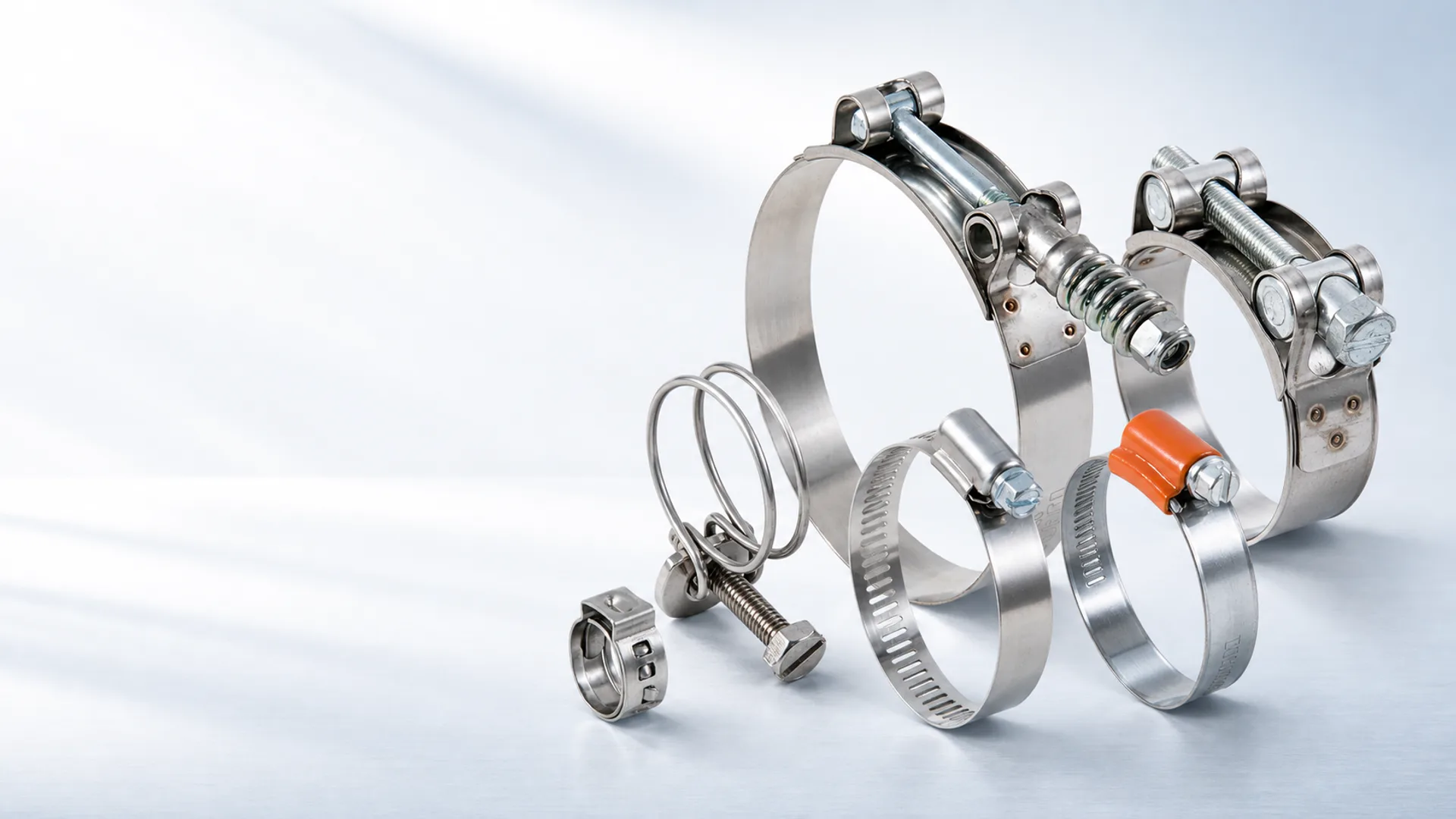
Pipe Maintenance Hose Clamp Selection: American, German, and Heavy Duty Clamps
In pipe maintenance, a hose clamp is a small component with a large impact on sealing reliability. Water lines, drainage hoses, ventilation ducts, automotive cooling hoses, machinery pipelines, irrigation systems, pump connections, and industrial auxiliary lines can all fail because of the wrong clamp type, poor material selection, incorrect sizing, or excessive tightening.
Good hose clamp selection is not only about diameter and price. Maintenance teams should also consider working pressure, vibration, installation space, hose material, medium, temperature, humidity, corrosion risk, and how often the line will be inspected or replaced. American hose clamps, German hose clamps, and heavy duty hose clamps serve different pipe maintenance needs.
Why hose clamp selection matters in pipe maintenance
The goal of pipe maintenance is to reduce leakage, avoid unexpected downtime, and extend the service life of hoses, fittings, and equipment. If a clamp is too loose, the hose may not seal against the fitting and fluid, gas, or dust can escape. If a clamp is over-tightened, the hose can be damaged, the screw can strip, the band can deform, or the clamp can lose stable holding force after vibration.
Hose clamps are commonly used during hose replacement, equipment inspection, emergency repair, reinforcement of aging lines, and new pipe installation. Because every pipe position has different pressure and movement, one clamp type cannot cover every maintenance task.
American hose clamps for low-pressure general maintenance
American hose clamps usually use a perforated or slotted band. The screw engages with the band openings to tighten the clamp. This structure gives the clamp a wide adjustment range, which is helpful for field repair, mixed hose sizes, and inventory control.
For pipe maintenance, American hose clamps are suitable for low-pressure water hoses, drainage lines, ventilation ducts, agricultural irrigation, household repair, and general auxiliary equipment lines. They are easy to install and often cost less than heavier clamp types.
The limitation is band strength. The perforated band is not as continuous as a solid band, so over-tightening, high pressure, high vibration, or impact load can deform the band or tear the perforations. For high-pressure or long-running machinery pipelines, American hose clamps should not be the first choice.
German hose clamps for stable sealing and vibration resistance
German hose clamps are designed with a stronger band and more stable screw engagement. They distribute tightening force more evenly around the hose, which helps improve sealing reliability and reduce local hose damage. Common band widths include 9 mm and 12 mm.
German hose clamps are widely used for automotive cooling hoses, intake lines, industrial water lines, machinery auxiliary pipelines, and medium-pressure pipe connections. They are a practical choice when the pipe needs more stable sealing, better vibration resistance, and a longer maintenance interval.
For humid, outdoor, automotive, construction, and industrial environments, 304 stainless steel German hose clamps are usually recommended. For salt spray, coastal projects, chemical exposure, or stronger corrosion risk, 316 stainless steel can provide better long-term resistance.
Heavy duty hose clamps for high pressure and demanding pipe systems
Heavy duty hose clamps are used when the pipe system requires higher clamping force, larger size coverage, and better resistance to pressure, vibration, or movement. They usually have a thicker band, stronger bridge structure, and bolt tightening design.
Typical applications include construction machinery, heavy vehicles, hydraulic auxiliary lines, industrial rubber hoses, pump and valve connections, mining equipment, marine equipment, and large-diameter hose maintenance. If a standard hose clamp frequently loosens, strips, or cannot provide enough holding force, a heavy duty clamp is often the safer option.
However, heavy duty clamps are not necessary for every application. They are larger, more expensive, and require enough installation space. On thin or soft hoses, excessive clamping force can damage the hose wall. The hose material, fitting design, and tightening torque should be checked before use.
Quick comparison for maintenance teams
| Clamp type | Structure | Pressure suitability | Main advantage | Common pipe maintenance use | |---|---|---|---|---| | American hose clamp | Perforated band, wide adjustment range | Low to medium-low pressure | Low cost, easy inventory, fast installation | Drainage, ventilation, irrigation, household repair | | German hose clamp | Stronger band, even tightening | Medium to medium-high pressure | Stable sealing and better vibration resistance | Automotive hoses, machinery lines, industrial water pipes | | Heavy duty clamp | Thick band, bolt tightening, high clamping force | Medium-high to high pressure | Strong holding force for large or demanding hoses | Construction machinery, pumps, valves, hydraulic auxiliary lines |
Choose material by working environment
For dry indoor maintenance, zinc-plated steel or stainless steel can be selected depending on cost and service life requirements. Zinc-plated clamps can be economical for temporary low-pressure repair, but they are not ideal for long-term humid environments.
For humid, outdoor, automotive, construction, and industrial maintenance, 304 stainless steel is usually a better choice. It provides stronger rust resistance and is more suitable for long service life.
For coastal areas, salt spray, chemical exposure, food equipment areas, or corrosive media, 316 stainless steel should be considered. Although the unit cost is higher, it can reduce corrosion failure and repeated maintenance.
Size and torque are as important as clamp type
When selecting clamp size, measure the actual outside diameter of the hose after it is installed on the fitting. Do not rely only on nominal hose inner diameter. The clamp range should cover the actual outside diameter and leave adjustment margin. Avoid selecting a clamp where the hose diameter sits exactly at the minimum or maximum range.
Tightening torque also matters. Too little torque may cause leakage; too much torque may damage the hose, strip the screw, deform the band, or tear perforations. For automotive, machinery, and industrial pipe maintenance, torque-controlled installation is recommended whenever possible.
Practical selection recommendation
Choose an American hose clamp for low-pressure, general, temporary, or mixed-size maintenance. Choose a German hose clamp for long-running pipe systems that need more stable sealing and vibration resistance. Choose a heavy duty hose clamp for high-pressure, large-diameter, heavy-load, or repeated-failure locations.
When purchasing hose clamps for pipe maintenance, provide the hose outside diameter, medium, working pressure, temperature range, vibration condition, installation space, and environment. Demeite can recommend suitable clamp types, materials, and sizes for automotive, construction, industrial, and general maintenance applications.
Q&A
Q1: Which hose clamp is most common in pipe maintenance?
American hose clamps are common for low-pressure general maintenance. German hose clamps are widely used for automotive, machinery, and industrial pipe systems. Heavy duty clamps are preferred for high-pressure, large-diameter, or heavy-load connections.
Q2: Can American hose clamps be used on automotive pipelines?
They can be used in some low-pressure positions, but for lines with vibration, temperature change, and higher sealing requirements, German hose clamps or heavy duty clamps are usually more suitable.
Q3: When should stainless steel hose clamps be used?
Use stainless steel for humid, outdoor, long-service, automotive, construction, industrial, or corrosion-risk environments. 304 stainless steel is suitable for many general applications, while 316 stainless steel is better for salt spray and chemical exposure.
Q4: Are heavy duty clamps always better?
No. Heavy duty clamps are useful for high pressure, heavy load, and large hoses, but they may be too large or too strong for thin or soft hoses. The hose material, fitting shape, and installation space should be considered.
Q5: How can maintenance staff decide whether a hose clamp needs replacement?
Replace the clamp if it shows rust, stripped screw threads, cracked band edges, deformed perforations, leakage after tightening, or reduced holding force after removal and reinstallation.