Heavy Duty Clamp vs Standard Hose Clamp: Selection Guide for Large-Diameter Pipe Sealing
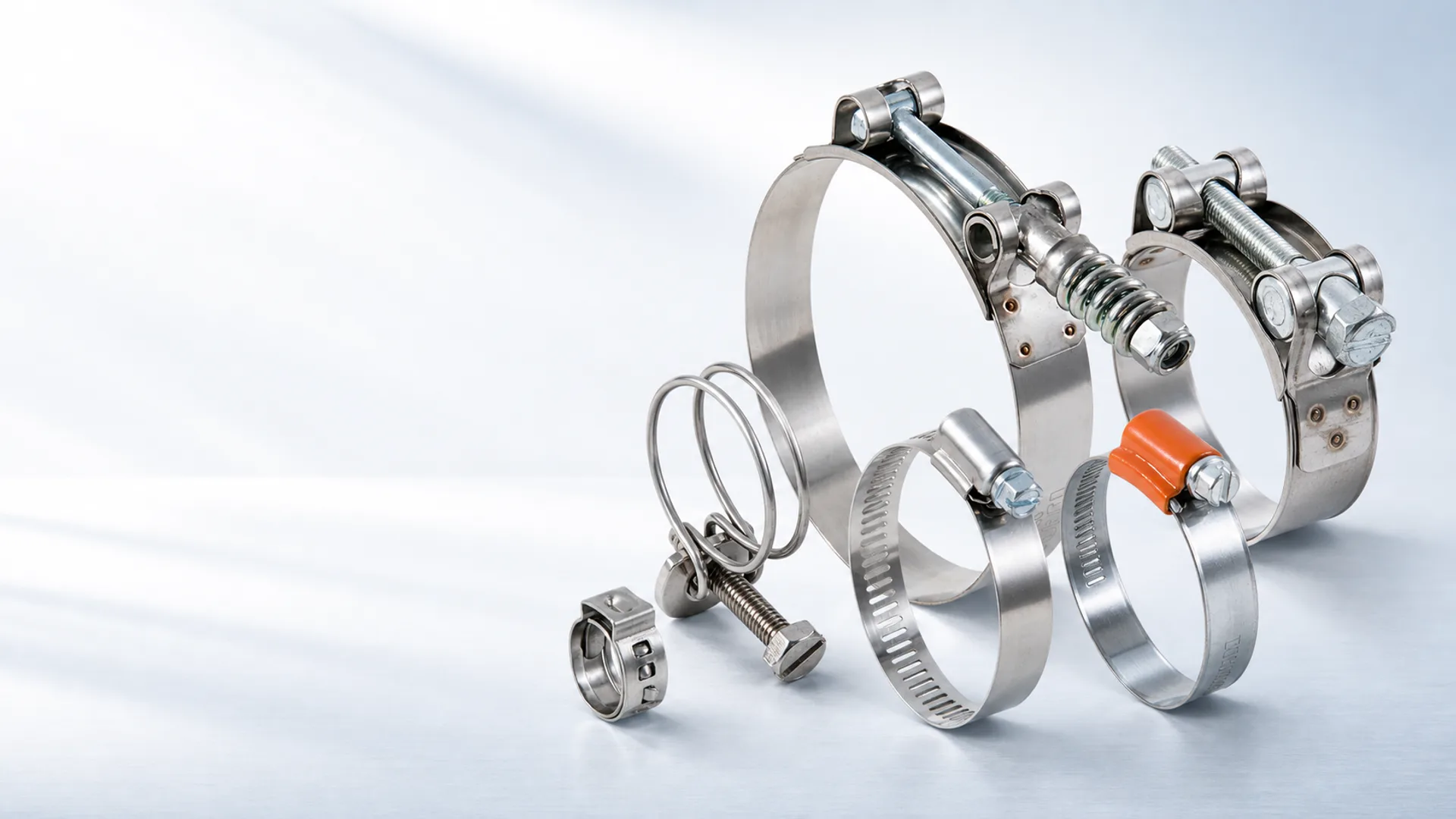
Heavy Duty Clamp vs Standard Hose Clamp: Selection Guide for Large-Diameter Pipe Sealing
In automotive piping, construction machinery, turbocharger systems, high-pressure water lines, and large-diameter pipe connections, choosing the right clamp has a direct impact on sealing performance, vibration resistance, and maintenance cost. Standard German-style and American-style hose clamps work well for many small hose connections, but they may not provide enough stable clamping force in large-diameter, high-pressure, or high-vibration applications. In these cases, a heavy duty clamp is usually the better choice.
A heavy duty clamp is designed for high-load sealing connections. It usually uses a thicker band, a stronger bolt structure, and higher clamping force. This makes it suitable for larger diameters, higher pressure, and equipment exposed to vibration or impact. For industrial equipment, heavy vehicles, mining machinery, turbocharger piping, and high-pressure transfer lines, heavy duty clamps provide more stable sealing than standard hose clamps.
Where are standard hose clamps used?
Standard hose clamps include German-style, American-style, and British-style clamps. They commonly use a single screw or worm-drive structure, with a thinner steel band, easy installation, and lower cost. They are mainly used for small-diameter, low-pressure, or medium-duty hose connections.
For most hose connections below 50 mm, a standard hose clamp can usually provide enough fixing and sealing performance. Typical applications include low-pressure automotive hoses, ventilation ducts, household equipment hoses, light machinery pipelines, general water drainage hoses, and low-pressure air lines.
The main advantages of standard hose clamps are simple installation, wide size availability, and lower purchasing cost. However, when the diameter increases, pressure rises, or the connection is exposed to long-term vibration and impact, standard hose clamps may show insufficient tightening force, unstable sealing, leakage, or loosening.
Why are heavy duty clamps better for large-diameter pipes?
Heavy duty clamps are commonly used for large hoses, thick-wall pipes, and high-strength sealing connections. Compared with standard hose clamps, they have a stronger structure, thicker band, and higher-strength bolts, allowing them to generate greater clamping force.
The advantages of heavy duty clamps can be summarized in three points.
First, they provide stronger tightening force. Large-diameter pipes require higher radial compression. The band and bolt structure of a standard hose clamp may not provide enough pressure, while a heavy duty clamp can press the joint more evenly and securely.
Second, sealing performance is more reliable. Heavy duty clamps can be used with rubber sealing rings to press the seal firmly around the pipe joint and reduce leakage risk under pressure. For working pressure above 10 bar, a heavy duty clamp is generally recommended instead of replacing it with a standard hose clamp.
Third, they offer better resistance to vibration and impact. Construction machinery, mining equipment, heavy vehicles, and turbocharger systems produce continuous vibration during operation. The locking structure of a heavy duty clamp is better suited for these conditions and helps reduce loosening or failure during long-term use.
When should spring band clamps be used?
In addition to heavy duty clamps and standard hose clamps, spring band clamps are also common pipe fastening components. A spring band clamp uses the elasticity of spring steel to maintain clamping force. It does not require screw tightening and can usually be installed quickly with clamp pliers.
The key advantage of a spring band clamp is automatic compensation for hose expansion, contraction, aging, and slight dimensional changes. This makes it suitable for hose connections where temperature changes are frequent and long-term stable clamping force is required.
Common applications include automotive cooling systems, heater hoses, engine water hoses, small circulation water lines, and hose systems requiring fast assembly. However, the clamping force of a spring band clamp is limited, so it is not suitable for high-pressure, large-diameter, or high-impact pipelines. If the pipe is large or pressure is high, a heavy duty clamp should be considered first.
Selection advice for large-diameter pipe clamps
When selecting a pipe clamp, focus on diameter, pressure, material, and installation environment.
For small-diameter, low-pressure, and general hose connections, German-style, American-style, or British-style hose clamps are usually suitable. For large-diameter, high-pressure, high-vibration, or industrial equipment piping, heavy duty clamps are recommended. For automotive cooling hoses and heater hoses that experience frequent temperature changes, spring band clamps can be a good choice.
In terms of material, zinc-plated steel clamps are suitable for indoor or low-corrosion environments and can reduce purchasing cost. For outdoor, humid, corrosive, or long-service environments, 304 stainless steel or 316 stainless steel clamps are recommended. For food processing, chemical environments, coastal areas, and high-humidity applications, 316 stainless steel usually provides better corrosion resistance.
When installing a heavy duty clamp, tighten the bolts evenly and avoid one-sided locking. For double-bolt or T-bolt structures, tighten gradually in steps so the band is evenly loaded and the sealing ring remains properly seated against the pipe joint.
Selection reference
| Working condition | Recommended clamp type | Notes | |---|---|---| | Low-pressure hose below 50 mm | Standard German/American hose clamp | Lower cost and easy installation | | Automotive cooling hose | Spring band clamp | Compensates for thermal expansion and contraction | | Large-diameter pipe connection | Heavy duty clamp | Higher clamping force | | Pressure above 10 bar | Heavy duty clamp | More stable sealing | | High-vibration equipment | Heavy duty clamp | Better resistance to loosening | | Outdoor humid environment | 304 stainless steel clamp | Better corrosion resistance | | Chemical, coastal, or highly corrosive environment | 316 stainless steel clamp | Stronger corrosion resistance |
Demeite supplies heavy duty clamps, standard hose clamps, spring band clamps, and other fastening products for automotive, construction, and industrial pipe systems. We can provide product selection advice based on pipe diameter, pressure requirement, material demand, and working environment.
Q&A
Q1: What is the main difference between a heavy duty clamp and a standard hose clamp?
The main difference is clamping force and structural strength. Standard hose clamps are generally used for small-diameter, low-pressure hose connections, while heavy duty clamps are better for large-diameter, high-pressure, high-vibration, or high-sealing applications.
Q2: From what pipe diameter should a heavy duty clamp be considered?
There is no single fixed boundary, but standard hose clamps are commonly used for hoses below 50 mm. If the pipe diameter is above 50 mm, the wall is thick, pressure is high, or equipment vibration is obvious, a heavy duty clamp should be considered. In construction machinery, turbocharger piping, and industrial equipment, vibration and pressure may require a heavy duty clamp even when the diameter is not very large.
Q3: Is a heavy duty clamp necessary above 10 bar?
For pressure above 10 bar, it is generally not recommended to replace a heavy duty clamp with a standard hose clamp. A standard clamp has limited band thickness and locking strength, which may lead to unstable sealing under high pressure. A heavy duty clamp provides higher radial compression and is more suitable for high-pressure pipe joints with sealing rings.
Q4: Why are spring band clamps often used in automotive cooling systems?
Automotive cooling systems experience frequent temperature changes, and hoses expand, contract, and age over time. A spring band clamp maintains continuous clamping force through spring steel elasticity and compensates for hose size changes. This makes it suitable for cooling hoses, heater hoses, and engine circulation hoses, but not for high-pressure or large-diameter pipelines.
Q5: Should a heavy duty clamp use zinc-plated steel, 304 stainless steel, or 316 stainless steel?
Zinc-plated steel is suitable for dry and low-corrosion environments where cost control is important. 304 stainless steel is recommended for outdoor, humid, or long-service applications. 316 stainless steel is more suitable for coastal, chemical, corrosive, or high-humidity environments.
Q6: What should be considered during heavy duty clamp installation?
Confirm that the size matches the pipe, place the sealing ring correctly, and tighten the bolts gradually and evenly. Do not fully tighten one side at once, as this may cause uneven band force, sealing ring displacement, or local leakage. For double-bolt structures, alternate tightening between both sides.
Q7: Can a standard hose clamp temporarily replace a heavy duty clamp?
In low-pressure, small-diameter, short-term testing applications, a standard hose clamp may sometimes be used temporarily. For real operating conditions involving high pressure, large diameter, or strong vibration, it is not recommended because it may increase the risk of leakage, loosening, and maintenance failure.
Q8: How can I quickly decide which clamp to use?
Ask three questions: Is the pipe diameter large? Is the pressure high? Does the equipment vibrate continuously? If two of these conditions are true, a heavy duty clamp is usually recommended. If the main issue is temperature change and hose aging compensation, consider a spring band clamp. If it is a normal small-diameter, low-pressure hose connection, a standard hose clamp is usually enough.