Hose Clamp Heavy Duty Use Cases: When Should You Choose a Heavy Duty Hose Clamp?
Hose Clamp Heavy Duty Use Cases: When Should You Choose a Heavy Duty Hose Clamp?
For many hose connections, an American hose clamp or German hose clamp is enough for low-pressure and medium-pressure service. But when the pipe diameter is larger, the hose wall is thicker, the connection is exposed to vibration, or standard clamps repeatedly loosen, a hose clamp heavy duty solution becomes the better choice.
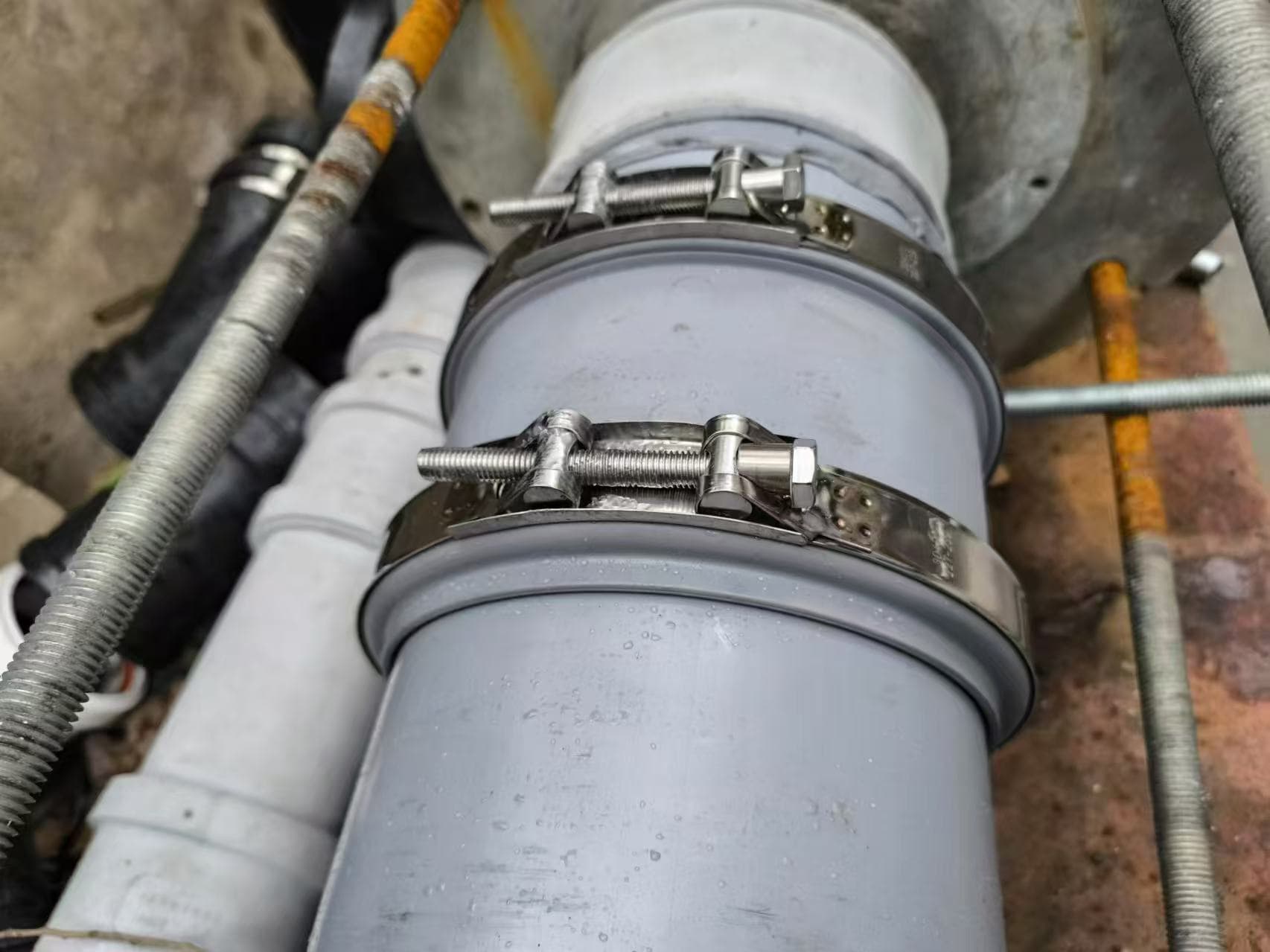
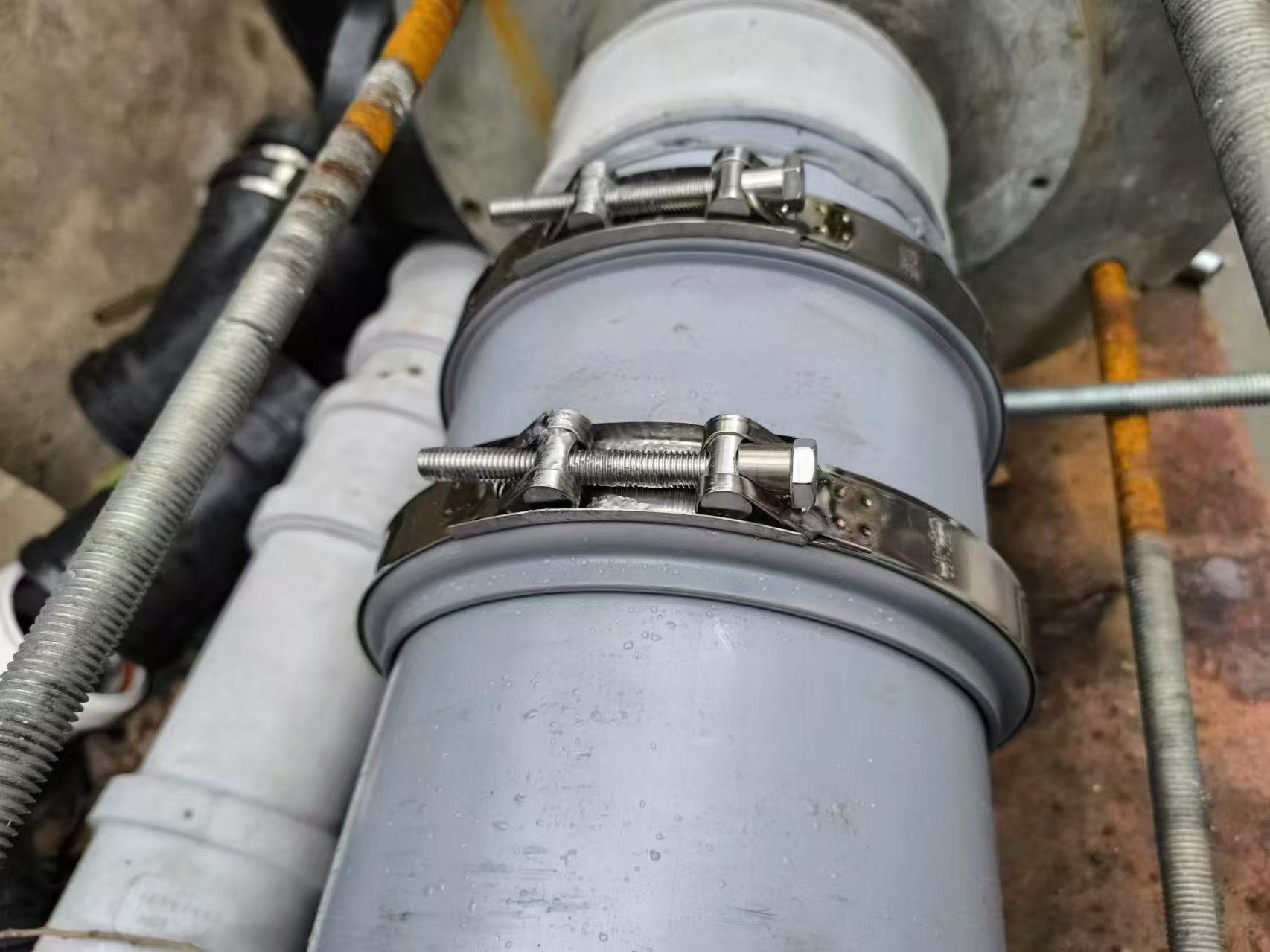
The installation photo below shows a typical large pipe connection. The connection uses heavy duty hose clamps to provide stronger holding force and better sealing stability, reducing the risk of loosening, leakage, and pipe movement during operation.
What is a hose clamp heavy duty?
A hose clamp heavy duty is a stronger clamp designed for demanding hose and pipe connections. Compared with standard worm gear clamps, it usually has a thicker band, stronger bolt tightening structure, and higher clamping force. It is suitable for large-diameter hoses, thick rubber sleeves, vibration, and applications requiring more stable sealing.
Demeite's Single Bolt Solid Heavy Duty Clamp is a typical heavy duty hose clamp product. It is designed for automotive, construction, machinery, ventilation, plumbing, and industrial hose or pipe assemblies.
Where are heavy duty hose clamps used?
Heavy duty hose clamps are not required for every hose connection, but they are useful in these conditions:
- Large-diameter hose or pipe joints
- Thick rubber hoses, drainage pipes, ventilation ducts, and industrial hoses
- Pump and valve connections, machinery pipelines, and auxiliary hydraulic lines
- Equipment environments with vibration, impact, or temperature movement
- Locations where standard hose clamps strip, deform, or loosen repeatedly
- Maintenance or engineering projects requiring stronger sealing reliability
As shown in the photo, heavy duty clamps are often used on large plastic pipes, rubber couplings, equipment interfaces, and compact installation sites. In these connections, the clamp is not only holding the hose in place; it also helps seal, resist movement, and maintain connection stability.
Why standard hose clamps may not be enough
Standard hose clamps are practical for smaller diameters and lower pressure connections. On larger pipes, however, the band contact area, clamping force, and deformation resistance may be insufficient. Over-tightening a standard clamp can deform the band, strip the screw, or damage the hose surface.
A heavy duty hose clamp uses a stronger band and bolt tightening structure to provide greater holding force. For industrial maintenance, drainage systems, construction machinery, and large pipe connections, it can reduce loosening and repeated maintenance.
Typical application industries
| Industry or system | Common connection point | Why heavy duty clamps help | |---|---|---| | Construction drainage | Large pipe joints, rubber couplings, drainage pipe interfaces | Requires stable sealing and resistance to movement | | Industrial equipment | Pump connections, equipment hoses, auxiliary lines | Long operating time and stronger vibration | | Automotive and machinery | Cooling hoses, intake hoses, exhaust ducts, thick hoses | Needs higher clamping force and vibration resistance | | Ventilation systems | Flexible duct connections and hose interfaces | Large diameter and shape movement can affect sealing | | Pipe maintenance | Aging pipe repair, temporary reinforcement, leak control | Helps restore sealing and fastening quickly |
How to choose the correct heavy duty clamp size
Measure the actual outside diameter of the hose, sleeve, or pipe connection after it is installed on the fitting. Do not rely only on the nominal pipe size. The clamp range should cover the actual outside diameter and leave adjustment margin.
For wide couplings, larger diameters, or higher sealing requirements, two heavy duty clamps may be installed across the connection area, as shown in the photo. Whether two clamps are necessary depends on the coupling width, pipe structure, hose material, pressure, and available installation space.
Material selection
For dry indoor use, zinc plated steel or stainless steel can be selected according to cost and service life. For humid, outdoor, construction drainage, equipment room, and long-service environments, 304 stainless steel is recommended. For coastal areas, salt spray, chemical exposure, or highly corrosive environments, 316 stainless steel should be considered.
For heavy duty clamps, material affects not only corrosion resistance but also maintenance cost. Rusted bolts can become difficult to remove, and corroded bands may lose clamping performance. In wet or industrial environments, the lowest initial price is not always the best long-term choice.
Installation notes
Place the heavy duty clamp over the supported sealing area of the joint, not directly on the hose edge. Tighten gradually and evenly to avoid uneven pressure on one side of the pipe or hose.
For plastic pipes, PVC pipes, or soft rubber couplings, avoid excessive tightening. A heavy duty clamp can apply high clamping force; if the hose or fitting cannot support that force, deformation, crushing, or cracking may occur.
Product recommendation
For projects involving large-diameter hoses, thick rubber sleeves, industrial pipelines, or vibration-prone connections, Demeite's Single Bolt Solid Heavy Duty Clamp is a practical reference product.
It is suitable for automotive, construction, machinery, ventilation, plumbing, and industrial hose connections. For accurate selection, provide the pipe outside diameter, hose material, working pressure, humidity, vibration condition, installation space, and quantity.
Q&A
Q1: When do I need a hose clamp heavy duty?
Use a heavy duty hose clamp when the pipe diameter is large, the hose wall is thick, the connection vibrates, standard clamps loosen repeatedly, or stronger sealing reliability is required.
Q2: Can heavy duty hose clamps replace all standard hose clamps?
No. Heavy duty clamps provide higher clamping force and are best for demanding applications. For small hoses, thin-wall hoses, or plastic fittings, a German hose clamp may be more suitable.
Q3: Why are two heavy duty clamps sometimes used on large pipe joints?
Two clamps can distribute clamping force across a wider sealing area and improve connection stability, especially on wide couplings, large pipes, and vibration-prone installations.
Q4: Should I choose 304 or 316 stainless steel?
Choose 304 stainless steel for common outdoor and humid environments. Choose 316 stainless steel for salt spray, coastal, chemical, or highly corrosive environments.
Q5: What information is needed for a heavy duty clamp inquiry?
Provide outside diameter, hose material, coupling width, working pressure, temperature, vibration condition, environment, and required quantity.