German, American, and British Hose Clamps: How to Choose the Right Type
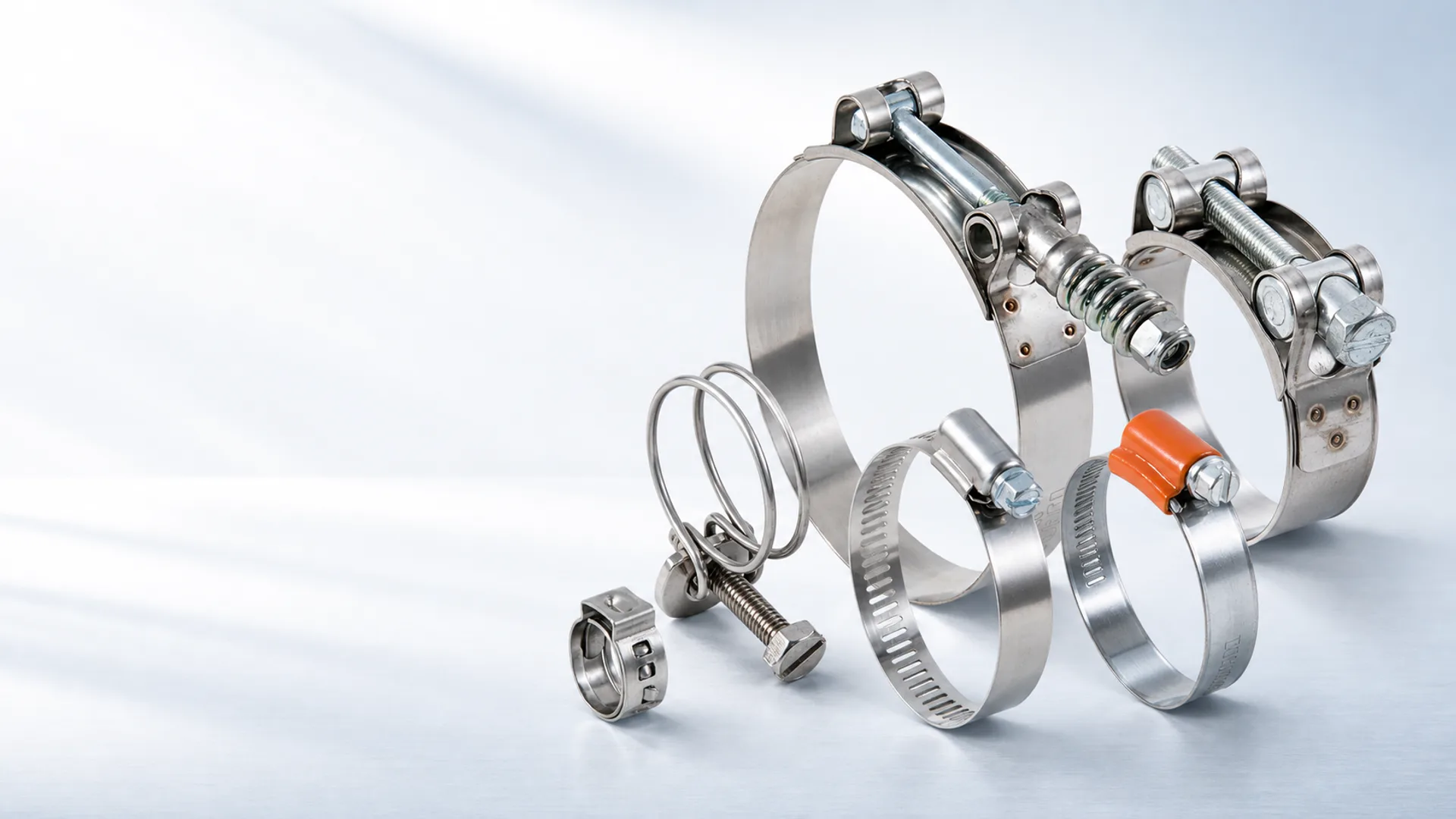
German, American, and British Hose Clamps: How to Choose the Right Type
When purchasing hose clamps, it is easy to confuse German, American, and British types. They may all look like a metal band with a screw, but their band design, tightening method, pressure suitability, cost, and application scenarios are different. Choosing the wrong clamp can lead to difficult installation, loosening, leakage, band damage, or sealing failure.
For automotive hoses, building water lines, ventilation systems, irrigation, household hardware, and industrial equipment, clamp selection should consider pipe diameter, pressure, vibration, medium, installation environment, and corrosion resistance. The following guide compares three common hose clamp types from a practical sourcing and engineering perspective.
German hose clamps: strong tightening force for medium and higher-pressure lines
German hose clamps are widely used in automotive and industrial applications. Their key features are a relatively thick band, stable screw and housing engagement, and more even tightening force. Compared with lightweight clamps, a German hose clamp can provide more stable clamping force and better sealing performance.
Common German hose clamps are available with 9 mm and 12 mm band widths. A 9 mm band is often used for small and medium hose diameters or compact installation spaces. A 12 mm band provides a larger contact area and is better for applications requiring more stable tightening. Size ranges may cover small hoses up to pipe connections above 200 mm, depending on the product series.
German hose clamps are suitable for automotive water hoses, intake pipes, auxiliary hydraulic lines, industrial equipment, and medium-pressure pipe systems with vibration. In long-running equipment or vibrating systems, German hose clamps generally resist loosening better than lightweight low-cost clamps.
For humid, outdoor, or long-service environments, 304 stainless steel is usually recommended. For salt spray, chemical exposure, or stronger corrosion risk, 316 stainless steel can be considered.
American hose clamps: wide adjustment range for low-pressure general use
American hose clamps are known for their perforated or slotted band. The screw engages with the band openings to tighten the clamp. This design provides a wide adjustment range, so one clamp size can cover a broader pipe diameter range. It is also convenient for purchasing, inventory, and field maintenance.
American hose clamps are usually cost-effective and easy to install. They are suitable for water supply and drainage, ventilation ducts, agricultural irrigation, household hardware, low-pressure air lines, and general repair work. For low-pressure hose connections with limited tightening requirements, an American hose clamp is often a practical choice.
However, the perforated band design reduces part of the band strength. If the clamp is over-tightened, or used in high-pressure, high-vibration, or high-impact conditions, the band may deform, tear at the perforations, or lose stable locking. For this reason, American hose clamps are not recommended as the first choice for high-pressure or heavy-duty equipment pipelines.
British hose clamps: lightweight and economical for low-pressure civil use
British hose clamps are lightweight clamps with a simple structure and low cost. Traditional British clamps are often made from zinc-plated steel, with a narrow band and relatively low tightening force.
Common applications include washing machine inlet hoses, low-pressure water hoses, low-pressure gas hoses, simple equipment hoses, and household repair. Their advantages are low price, light weight, and easy sourcing, but their corrosion resistance and clamping force are usually lower than stainless steel German clamps.
If a British hose clamp is used in humid, outdoor, or corrosive environments for a long time, the zinc coating may fail and the steel band may rust. For industrial equipment, outdoor projects, and long-service piping, stainless steel clamps are increasingly replacing lightweight zinc-plated options.
Quick comparison
| Type | Structure | Pressure suitability | Main advantage | Common applications | |---|---|---|---|---| | German hose clamp | Thicker band, even tightening, stable locking | Medium to medium-high pressure | Stable sealing and better vibration resistance | Automotive hoses, industrial equipment, auxiliary hydraulic lines | | American hose clamp | Perforated band, wide adjustment range | Low to medium-low pressure | Broad usability and lower cost | Drainage, ventilation, irrigation, household hardware | | British hose clamp | Lightweight structure, often zinc-plated steel | Low pressure | Economical and easy to install | Civil hoses, temporary fixing, low-pressure connections |
Three key points for hose clamp selection
The first point is material. Zinc-plated steel or stainless steel can be selected for normal indoor use depending on cost. For humid, outdoor, and long-service environments, 304 stainless steel is recommended. For salt spray, chemical exposure, coastal locations, and highly corrosive environments, 316 stainless steel is a better choice.
The second point is size. The clamp range should cover the actual outside diameter of the hose after installation and leave enough adjustment margin. Do not choose a size where the hose diameter sits exactly at the minimum or maximum limit of the clamp.
The third point is tightening torque. Each hose clamp type has a reasonable tightening torque. Too little torque may cause leakage, while too much torque may strip the screw, deform the band, tear perforations, or damage the hose. Torque control is especially important for stainless steel clamps and soft rubber hoses.
Practical recommendation
Choose a German hose clamp when stable sealing and stronger tightening force are required. Choose an American hose clamp when wide adjustment range, general usability, and cost control are more important. Choose a British hose clamp for low-pressure civil use or temporary fixing.
For automotive, construction, and industrial projects, Demeite recommends selecting clamps based on pipe diameter, pressure level, vibration, installation space, and working environment. If necessary, provide the hose outside diameter, hose material, medium, working pressure, and environmental conditions so the supplier can recommend the suitable clamp type and material.
Q&A
Q1: What is the main difference between German and American hose clamps?
German hose clamps usually have a thicker band and more even tightening force, making them suitable for medium-pressure and vibrating pipelines. American hose clamps use a perforated band, offer a wider adjustment range, and are more cost-effective for low-pressure general connections.
Q2: Can American hose clamps be used for high-pressure pipelines?
Generally, no. The perforated band reduces continuous band strength. In high-pressure or high-vibration conditions, it may deform, tear at the holes, or lose stable locking. For high-pressure pipelines, German clamps, heavy duty clamps, or stronger fastening solutions are recommended.
Q3: How should I choose between 9 mm and 12 mm German hose clamps?
A 9 mm band is suitable for small and medium hoses or compact installation space. A 12 mm band provides a larger contact area and better tightening stability. Final selection should consider hose outside diameter, hose material, pressure, and installation space.
Q4: Why are British hose clamps not ideal for humid environments?
Many British hose clamps are made from zinc-plated steel. In humid or corrosive environments, the coating may fail over time and the band may rust, reducing holding strength and service life. For outdoor or humid applications, 304 stainless steel clamps are recommended.
Q5: How should hose clamp size be selected?
Measure the actual outside diameter of the hose after it is installed on the fitting, then select a clamp range that covers that diameter with adjustment margin. Avoid choosing a clamp where the hose diameter is at the exact minimum or maximum limit.
Q6: What is the difference between 304 and 316 stainless steel clamps?
304 stainless steel is suitable for most outdoor, humid, and general industrial environments. 316 stainless steel has stronger resistance to chloride and chemical corrosion, making it better for coastal, chemical, high-humidity, or corrosive environments.
Q7: How can I quickly decide which hose clamp type to use?
Use an American hose clamp for low-pressure, cost-sensitive, and wide-adjustment applications. Use a German hose clamp for medium-pressure, vibrating, and stable-sealing applications. Use a British hose clamp for low-pressure civil use or temporary fixing.